
What is a text adventure / IF - click to find out!
A HISTORY OF INTERACTIVE FICTION
> WHAT IS A TEXT ADVENTURE?
Imagine sitting in front of a computer in 1982. There is no high-resolution display, no soundtrack, no animated character running across the screen and no mouse.
Instead, the screen contains words.
You type:
> OPEN DOOR
The computer replies:
THE DOOR IS LOCKED.
You have just entered the world of the text adventure.
Text adventures are a form of interactive fiction — computer-based stories in which the player explores a fictional world and influences what happens by making decisions.
Instead of simply reading a story, you participate in it. The computer describes the world. You decide what to do. The program interprets your instructions and changes the story accordingly.
That simple idea is surprisingly powerful. A text adventure can contain rooms, characters, objects, puzzles, dangers, humour, mysteries and entire fictional worlds — all represented by nothing more than words on a screen.
> BEFORE THE HOME COMPUTER
The origins of the text adventure lie in the early days of computing, long before computers became household objects.
In the early 1970s, computers were generally enormous, expensive machines operated by universities, government organisations and large companies. They did not have graphics cards, sound chips or modern operating systems. Many were accessed through simple text terminals, and a handful of educational and research networks — most famously the PLATO system in the United States — were already experimenting with early text-based games and simulations for students to play between lessons.
In this unlikely environment, a programmer named William Crowther created a program that would change computer entertainment forever.
Around 1975-76, Crowther — a caving enthusiast working at Bolt, Beranek and Newman — wrote Adventure on a PDP-10 mainframe, partly inspired by the real Mammoth Cave system in Kentucky, which he had explored and mapped himself, and partly as something he could share with his young daughters after a divorce. The player explored an underground cave, discovering objects, solving puzzles and encountering creatures and dangers.
The program was later discovered and expanded by a Stanford student, Don Woods, who — with Crowther's blessing — added much of the fantasy scenery, magic words and scoring for which the game became famous, growing it from Crowther's original version into a much larger 350-point (and later 550-point) adventure.
The result became known as Colossal Cave Adventure, or simply Adventure. It spread from mainframe to mainframe across the fledgling ARPANET, reportedly bringing productivity at more than one research lab to a standstill as people stayed up all night trying to escape the cave.
It established many of the conventions that would define the genre for decades: exploring a map, collecting objects, solving puzzles, interacting with the environment and trying commands to discover what the computer would allow you to do.
> HOW DID THEY WORK?
Early adventures were essentially conversations between the player and the computer.
The player might type:
> TAKE LAMP
> LIGHT LAMP
> GO NORTH
> EXAMINE DOOR
Behind the scenes, the program contained a map, objects, characters, puzzles and rules determining what happened when the player interacted with them.
This was revolutionary because the same story could unfold differently for different players. The player was no longer simply following a predetermined sequence.
You could experiment. You could make mistakes. You could discover things the author had hidden away. You could even attempt completely ridiculous actions just to see what would happen.
> THE FIRST MICROCOMPUTER ADVENTURES
Colossal Cave Adventure lived on giant mainframes, far beyond anything an ordinary person could own. The genre's next leap came from an American programmer named Scott Adams, who set himself the challenge of shrinking the whole idea of an adventure game down to fit inside the tiny memory of a home microcomputer.
In 1978, Adams released Adventureland, generally regarded as the first adventure game written specifically for a microcomputer rather than a mainframe. It squeezed a map, objects and puzzles into just a few kilobytes by using a simple, highly compressed database structure rather than Crowther and Woods's original code.
Adams founded a company, Adventure International, and followed up with a long series of short, tightly-designed adventures — including Pirate Adventure, Mission Impossible, Voodoo Castle and The Count — sold on cassette tape for machines such as the TRS-80, Apple II and, later, home computers on both sides of the Atlantic.
Adams's engine and approach were hugely influential. Several of his games were later re-implemented under licence by British writer Brian Howarth, whose own Golden Baton series of adventures were sold through Adventure International's UK arm — helping seed the British adventure-writing scene that would flourish over the following few years.
> ZORK AND INFOCOM
One of the most famous names in interactive fiction is Infocom, founded on 22 June 1979 in Cambridge, Massachusetts by a group of MIT staff and students, including Marc Blank, Dave Lebling, Tim Anderson and Joel Berez.
Their first game, Zork, had begun life a few years earlier as a sprawling, in-joke-filled adventure written on MIT's mainframe — itself directly inspired by Crowther and Woods's Adventure. It was, by the standards of home computers, enormous, and getting it onto machines like the Apple II and TRS-80 required real engineering ingenuity: Blank and Berez designed a compact virtual machine, the Z-machine, so that each game could be written once and then run — via a small interpreter — on almost any home computer of the day, years before "write once, run anywhere" became a familiar idea in computing generally.
Because the original Zork was too large to fit into a single microcomputer release, it was split into three parts: Zork I (1980), Zork II (1981) and Zork III (1982) — with Zork I alone eventually selling well over a million copies.
Infocom became famous for its sophisticated parser. Players could type surprisingly natural instructions rather than being restricted to a tiny list of commands.
The computer attempted to understand what the player meant.
Infocom went on to produce a remarkable run of adventures across the 1980s, including Deadline and Suspect (murder mysteries), Starcross and Planetfall (science fiction), the Enchanter trilogy — Enchanter, Sorcerer and Spellbreaker — (fantasy, with spells typed as commands), Trinity, Wishbringer, Bureaucracy, Leather Goddesses of Phobos, Hollywood Hijinx and A Mind Forever Voyaging.
Many Infocom games shipped with elaborate props — maps, letters, trinkets and other "feelies" packed into the box — both to delight players and, in an age of easily-copied cassettes and disks, to act as informal copy protection.
Their games demonstrated that interactive fiction could be funny, frightening, mysterious, philosophical and emotionally serious — sometimes within the same game. Infocom was bought by Activision in 1986, and — after a run of quarterly losses — Activision closed the Cambridge studio in 1989, bringing the company's original run to an end after a decade that had produced some of the genre's most celebrated work.
> THE BRITISH HOME COMPUTER REVOLUTION
In Britain, text adventures became closely associated with the home-computer revolution of the late 1970s and early 1980s.
Machines such as the ZX Spectrum, BBC Micro, Commodore 64 and Amstrad CPC brought computer games into ordinary homes.
British companies began producing their own adventures, often selling them on cassette tape.
One landmark early release was The Hobbit, published by Melbourne House in 1982. Written by Veronika Megler and Philip Mitchell, it combined a full adaptation of Tolkien's story with characters — Gandalf, Thorin and the rest of the dwarves — who moved and acted on their own initiative around the map, independently of the player, rather than simply waiting to be triggered by the correct command. That sense of a living world beyond the player's immediate view made a huge impression at the time.
Among the most important adventure-writing houses to follow was Level 9 Computing, founded in 1981 by brothers Pete, Mike and Nick Austin, who built their own compact game engine, A-code, to squeeze surprisingly large worlds into the severe memory limits of 8-bit computers.
Level 9's early trilogy — Colossal Adventure, Adventure Quest and Dungeon Adventure — became known as the Middle-earth trilogy for its Tolkien-flavoured setting, and was later reissued, with the Tolkien references quietly removed, as Jewels of Darkness. They followed it with a science-fiction trilogy — Snowball (1983), Return to Eden (1984) and The Worm in Paradise (1985) — later collected as Silicon Dreams, and continued through the decade with titles such as Lords of Time, Red Moon, Knight Orc and The Secret Diary of Adrian Mole Aged 13¾, an adaptation of Sue Townsend's novel.
Other British companies, including Magnetic Scrolls, produced adventures with increasingly sophisticated writing and presentation.
Games such as The Pawn, Guild of Thieves and Jinxter demonstrated that an adventure could combine substantial text with illustrations and a more sophisticated interface, while CRL, Delta 4 and other smaller British labels kept the cassette-based text adventure alive throughout the decade.
> MORE THAN JUST A STORY
A text adventure is not simply a book that asks you questions. At its heart is a collection of interconnected systems.
There might be a locked door, a key hidden somewhere else, a character who knows the combination, a dangerous creature that appears after a certain event, and an object that can be used in an unexpected way.
The player has to discover how the world works.
This is why puzzles became such an important part of the genre.
Some puzzles were logical. Others required experimentation. Some were deliberately fiendish.
Learning the vocabulary of the game was itself part of the challenge. Players quickly learned that EXAMINE, SEARCH, TAKE, USE and OPEN could be just as important as finding the right object.
As the genre matured, designers grew increasingly conscious of the difference between a puzzle that felt fair — solvable through careful reading and logical thought — and one that felt arbitrary or unfair, requiring the player to guess at an object or action with no real clue it existed. Avoiding so-called "guess-the-verb" problems, where a sensible solution failed simply because the parser did not recognise the exact wording expected, became something of a badge of honour among the more careful adventure writers.
> HUMOUR, CHARACTER AND WRITING
The genre was not always serious.
One of Infocom's most famous games was The Hitchhiker's Guide to the Galaxy, created with the involvement of author Douglas Adams.
It reproduced the absurd humour of the books and radio series while deliberately playing with the conventions of interactive fiction — famously frustrating players with a puzzle that could only be solved by dying and starting again with knowledge from a previous attempt.
Another Infocom title, A Mind Forever Voyaging, explored much more serious subjects — artificial intelligence, surveillance and the long-term consequences of political choices — demonstrating the remarkable range of the medium at a time when most other computer games were still concerned with scoring points and avoiding aliens.
> THE GRAPHICAL REVOLUTION
By the late 1980s, computer games were changing rapidly.
The shift had actually begun several years earlier, when Sierra On-Line's Mystery House (1980) — designed by Roberta and Ken Williams — paired simple line-drawn illustrations with a traditional text parser, becoming one of the first widely distributed graphical adventures.
Graphical adventure games could show the player what a room looked like rather than requiring them to imagine it from words.
Games such as Maniac Mansion and later The Secret of Monkey Island demonstrated how graphical interfaces — where the player chose actions from a menu of verbs and clicked on objects on screen — could make adventure games increasingly accessible to a much wider audience than the parser-driven text adventure ever reached.
The traditional commercial text adventure gradually disappeared from the mainstream.
But it never really died.
> THE STORY CONTINUES
The ideas behind text adventures survived in the modern world of interactive fiction, kept alive by a small but dedicated community of hobbyist writers and players once the commercial industry had largely moved on.
Systems such as Inform, created by Graham Nelson, and TADS, created by Michael J. Roberts, made it possible for writers to build sophisticated adventures without having to construct an entire game engine from scratch — the same role once played by Infocom's own internal tools, now available to anyone.
An annual Interactive Fiction Competition, running since the mid-1990s, gave new writers a reason to finish and share their work, and produced widely admired modern pieces such as Adam Cadre's Photopia and Andrew Plotkin's Spider and Web — games that used the text-only form to do things a graphical game could not easily attempt, including playing deliberately with the order in which the story is told.
Modern interactive fiction can use traditional typed commands, menus, hyperlinks, maps, sound, pictures and many other technologies — including hypertext tools such as Twine, which grew the audience for interactive stories well beyond the traditional parser-based form.
Yet the central idea remains almost exactly the same as it was in the 1970s.
YOU DECIDE WHAT TO DO.
> KEY MILESTONES
A rough timeline of some of the moments that shaped the genre:
1977 — Don Woods expands Crowther's game into Colossal Cave Adventure, which spreads across ARPANET.
1978 — Scott Adams releases Adventureland, the first adventure built specifically for a microcomputer.
1979 — Infocom is founded at MIT; work begins on turning the mainframe game Zork into a commercial product.
1980 — Sierra On-Line's Mystery House pairs text with simple graphics; Infocom releases Zork I.
1981 — Level 9 Computing is founded in Britain by the Austin brothers.
1982 — Melbourne House releases The Hobbit, with characters that act independently of the player.
1983-85 — Level 9's science-fiction trilogy (Snowball, Return to Eden, The Worm in Paradise) is released across almost every major home computer.
1984-85 — Magnetic Scrolls releases The Pawn, combining illustration with text.
1984 — Infocom publishes The Hitchhiker's Guide to the Galaxy, co-written with Douglas Adams.
1985 — Infocom is bought by Activision.
1987 — Maniac Mansion helps establish the point-and-click graphical adventure as the genre's commercial future.
1989 — Activision closes Infocom's Cambridge studio.
1993 — Graham Nelson releases Inform, giving hobbyists a modern toolkit to keep writing text adventures.
1995 — The first annual Interactive Fiction Competition is held.
> A HOMAGE TO THE GENRE
These games are my own small homage to the great text adventures of the past.
They are inspired by the games that made computer storytelling so wonderfully imaginative: the vast underground world of Colossal Cave Adventure, the humour and imagination of Zork, the remarkable writing of Infocom, and the adventures that appeared on British home computers during the 1980s.
The technology is very different now. A modern web browser can do things that the programmers of the 1970s and 1980s could hardly have imagined. But there is something appealing about returning to the simplicity of the original idea.
Words appear on the screen.
You make a decision.
The world responds.
NO BUTTON MASHING.
NO CUT-SCENES.
JUST YOU, YOUR IMAGINATION
AND A COMPUTER WAITING FOR YOUR NEXT COMMAND.
These games are not intended to reproduce the limitations of an old computer. They are intended to capture some of the spirit that made those limitations so interesting.
When graphics were limited, your imagination supplied the scenery. When memory was scarce, a few carefully chosen words could suggest an entire world. When the computer could only understand a small vocabulary, discovering what it would accept became part of the game itself.
That is the magic of the text adventure.
So consider these games a small thank-you to the programmers, writers and players who helped create the genre — and to the wonderfully strange worlds that existed inside those old computers.
THE ADVENTURE CONTINUES...
> WHY DO THEY STILL MATTER?
Text adventures occupy a unique place in the history of computing because they proved that a computer did not need sophisticated graphics to create a convincing world.
A few lines of text could make the player imagine a castle, a haunted house, an underground cave or an entire medieval village.
More importantly, the player could experiment. You could try something sensible. You could try something ridiculous. You could deliberately do something dangerous simply to see what happened.
The computer would respond.
That simple idea — READ THINK TYPE DISCOVER — is the foundation on which decades of interactive storytelling were built.
> YOU ARE PLAYING IT.
■
More games
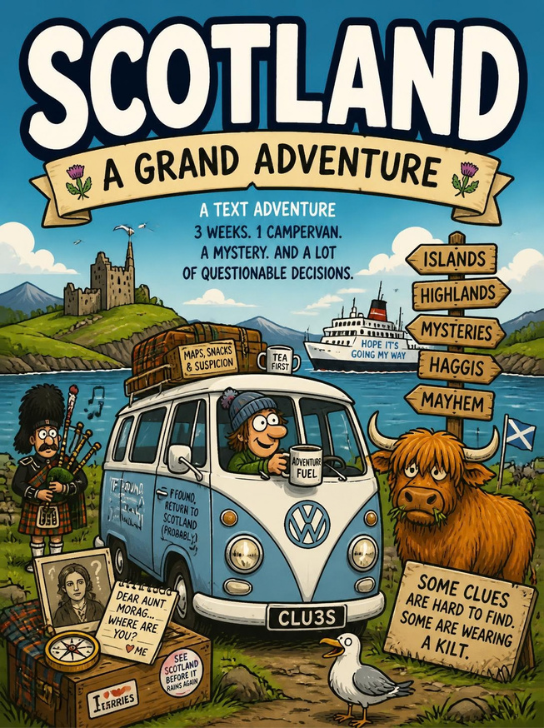
Three Weeks, One Camper and a Slightly Concerning Number of Sheep
You were under the impression that you were going to Scotland for three weeks.
483 points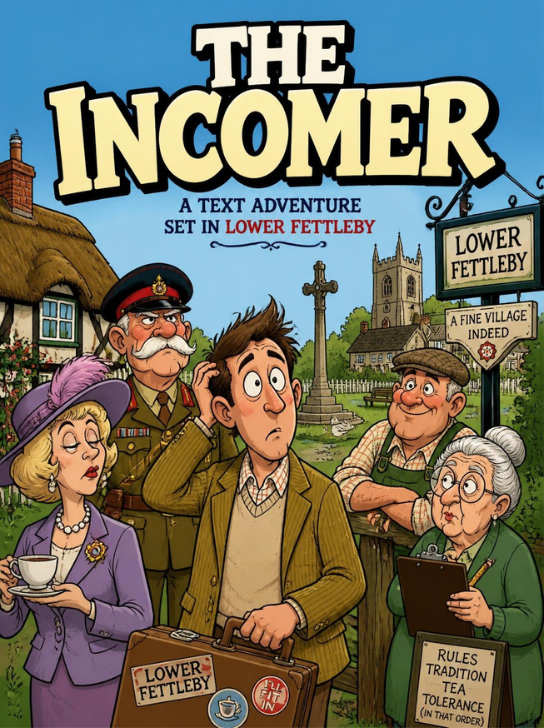
Incomers
This is the story of how you came to live in Lower Fettleby, and of the week it took Lower Fettleby to decide whether to let you.
300 points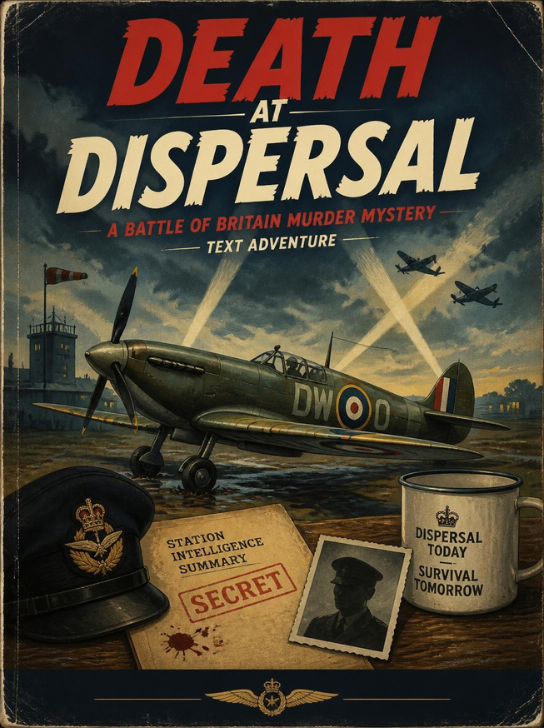
Death at Dispersal
The telephone went at twenty past five, and Mrs Doyle at the Hawksmoor exchange, who listens to everything, apologised for waking you before she put the call through.
400 points- Ackroyd & Sons
Ackroyd & Sons
You are wearing the suit you bought for a cousin's wedding, and which has since attended two funerals, a christening and a quiz night. It is a good suit. It has seen things.
169 points